|
This is a sample report. It's similar in format to those we'll publish starting in February 2010, in the new Journal of Illinois Lab Reports. The pursuit of academic excellence in secondary schools should be given the same attention as the pursuit of excellence in sports and other extracurricular activities. Many students do exemplary work in science, and since varsity athletes are celebrated in every medium, we celebrate the varsity science team. Chicago Voxitatis is now accepting lab reports from students or lab groups at Illinois high schools for consideration. As journal volumes are published, this column will feature a table of contents and a link to archived editions. This is not a peer-reviewed journal, and results should not be considered sound. In particular, some statements made in the introduction and discussion sections of any given report may not be accurate. We allow a limited time, during which users, including teachers and students, may post comments about each article. We encourage authors to check back regularly. Comments will be posted in the column at the right. The County Map
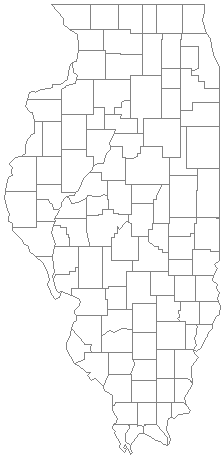
As articles are published, we will update the map to reflect the number of reports received from each county in Illinois. |
Rate of photosynthesis is directly proportional to intensity of light By Paul Katula Andrew High School, Tinley Park, Ill. Introduction In photosynthesis, plants (as well as some bacteria and some protistans) convert the radiant energy from sunlight into chemical energy in the bonds of glucose. In a complex series of reactions, glucose is made from carbon dioxide and water. In respiration, plants can convert the glucose into pyruvate, releasing adenosine triphosphate (ATP), which the cell needs for energy. The basic reaction for photosynthesis is carbon dioxide and water yields in the presence of light glucose and oxygen. Factors that affect the rate of photosynthesis in plants are light intensity, carbon dioxide concentration, and temperature. We tested how the rate of photosynthesis changes as light intensity changes by using Elodea leaves in a controlled experiment. Since oxygen is produced as a result of photosynthesis and released by the plant, we can count bubbles produced on the leaves themselves to measure the rate of photosynthesis. We expect the rate of photosynthesis to increase as light intensity increases and for the rate of photosynthesis to decrease as light intensity decreases, all other factors being held constant (external reference). The Light-Dependent Reactions The following diagram illustrates the flow of electrons in the light-dependent reactions involving two separate photosystems:  Note: If you include any images that you did not make yourself, we need the URL where you found the image, because we need to confirm that we have the right to publish the image. In some cases, we may need to use a different image that we can obtain permission to use. etc... The scientific concepts behind your hypothesis should be explained in sufficient detail to make your hypothesis a reasonable one. Include illustrations, graphs, and any drawings that help to illustrate the process. Materials and Methods Materials used and your exact method, including repeat trials and the controlling of any environmental variables, should be explained in enough detail for us to repeat the experiment ourselves. Sometimes we do that, just to make sure you're not trying to pass off data on us that wouldn't be accurate. Results Results should include your actual data. You'll have time to talk about it in the Discussion section of your lab report. This section may include a simple table. For example, I can imagine a table like the following:
Discussion Likely to be longer than any section except your introduction, this part of your lab report should discuss how your results support or refute your hypothesis. Use graphs or any other illustrations that may be necessary. Accepted for Publication: January 3, 2010 |
Submissions are accepted in electronic form only. To submit a lab report for publication consideration, email Include your name, email address, and phone number, as well as your school name, teacher's name, email address, and phone number. We are likely to have questions about your work, and we are not able to publish any work we can't confirm. Although reports and images can be accepted in just about any format, we prefer .DOCX (Microsoft Word) files for the tables and text and .JPG files for the images. Use the fictitious sample lab report on this page as a guideline for format only. You may suggest a title, but we reserve the right to change the title to fit in better in our table of contents. We also reserve the right to delete any images for which we cannot obtain publication permission from the copyright holder. We also reserve the right to edit your report for spelling, grammar, and style, in order to make it consistent with other reports in our publication.
Except where noted, all articles published in the Journal of Illinois Lab Reports retain the copyright © 2010 of their respective authors; attribution must be made as specified in the article by-line. By publishing the document here, some rights have been released, according to the license above, but others remain reserved. Our copyright license is among the most liberal licenses in all of publishing. We chose this license because our main purpose is to inspire good work in science in American high school classrooms. However, plagiarism is against the law in the United States. By plagiarizing this work from our Web site, you risk financial and other penalties, so don't do it. No part of this fairly liberal license gives anyone the right to use this work and claim it as his or her own research. |